The best months for an aurora cruise from Reykjavik
The northern lights boats in Reykjavik only sail while the nights are dark, which gives you roughly seven months to choose from. Each stretch trades long nights against rough weather in its own way. Pick your dates with both in mind, and leave a spare evening for a second try.
A season set by the dark
Around Reykjavik the aurora season runs roughly from September to mid-April. Outside that window the nights are too short and too bright for the lights to show, and the boats that look for them stay at the pier until autumn.
The aurora itself does not take the summer off. It glows above Iceland all year, but at about 64° north the summer sky never gets dark enough to see it. Darkness is the first thing you are booking.
First and last sailings shift a little from one operator to the next, so check the listing for the dates you have in mind. The evening cruises from the Old Harbour all follow that same rough window.
Month by month on the bay
Each part of the season balances darkness and weather differently. A rough guide follows, with the usual warning that a single week can break any pattern.
- September, the first dark nights, often mild with fairly calm seas, though true darkness arrives late in the evening
- October brings longer nights and the first weeks of the Imagine Peace Tower beam on Viðey, with autumn storms starting to roll in
- November to February, the longest nights of the year, with heavier cloud plus more sailings called off when gales come through
- March, nights still long enough while days stretch fast, with weather often kinder than in midwinter
- Early April, the tail of the season, when the light nights are close and darkness comes late
No month is a write-off and none is a sure thing. The lights are never guaranteed on any cruise, which is why the retry rules matter as much as the date (see what happens when the sky stays dark).
Long nights, rough weather
In midwinter the sun rises around 11 am and sets around 3:30 pm, so you get many dark hours to work with. On paper December and January look like the obvious choice.
The weather spoils that picture. Midwinter brings more low cloud and more storms off the Atlantic, and cloud is the usual reason a cruise comes back with nothing. Strong wind also raises a swell in Faxaflói Bay, and operators cancel when it gets rough.
If you are prone to a queasy stomach, a calmer month helps as much as any tablet. Our guide to seasickness on the bay covers where to sit and what to take before boarding.
Midwinter also asks for the warmest kit. Daytime temperatures sit around 0 °C (32 °F) and drop at night, and the wind on deck makes it feel much colder, so read what to wear on deck before you pack.
Why autumn and March often get the nod
It is often said that the weeks around the equinoxes (late September and March) bring more active auroras. There is a scientific explanation for it, but treat it as a small tilt in the odds and not a promise.
What these months tend to offer is gentler conditions. Autumn and March usually have milder air and fewer full gales than December, which means fewer cancelled sailings and a more pleasant hour at the rail.
The trade-off is fewer dark hours. In September and early April the sky only turns properly dark late in the evening, so each night gives a narrower slot and a short stay gives fewer chances.
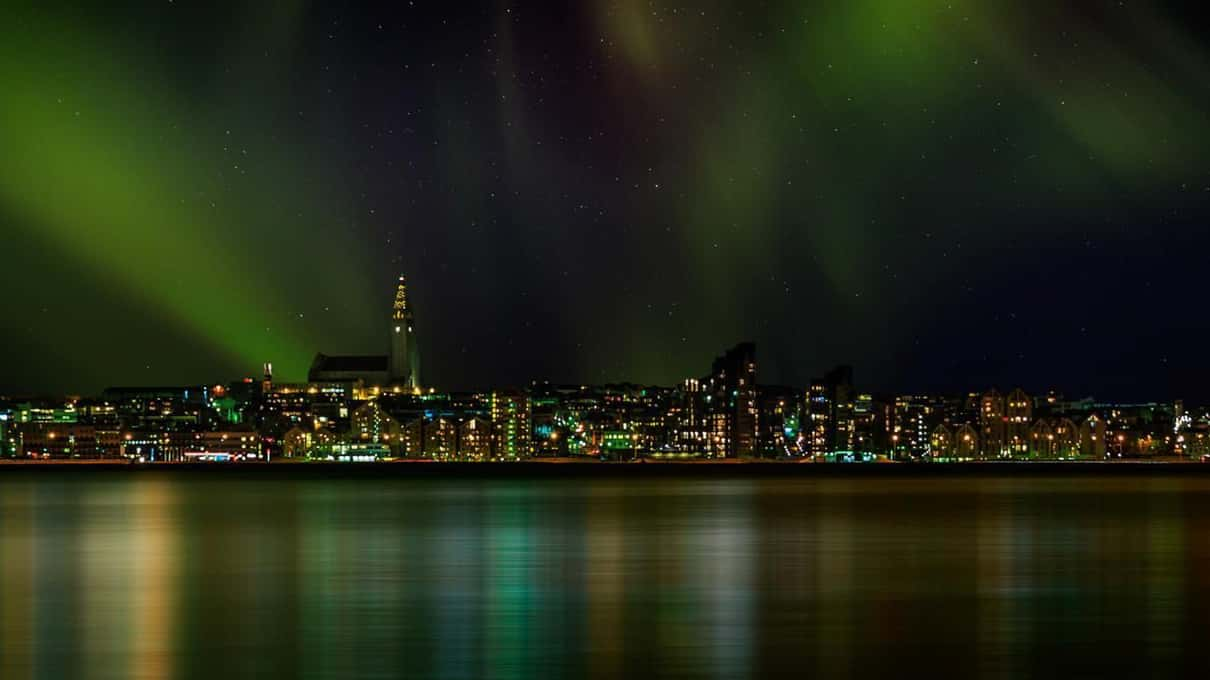
The Peace Tower beam, October to early December
From 9 October, John Lennon's birthday, to 8 December, the Imagine Peace Tower on Viðey sends a column of white light into the sky. It is also switched on for a few other nights through the year.
Elding's city cruise, from ~$105, names the tower as part of its route while it is lit. The beam makes a fine marker even on a night when the aurora stays faint.
For a picture with the beam and the lights in one frame, autumn is the only time to go. Our tips for aurora photos from a boat explain how to frame it from a deck that moves.
Cloud forecast first, Kp second
Aurora apps love the Kp index, a scale of geomagnetic activity. This far north even a modest reading can bring visible lights, while a high one is useless under a lid of cloud.
The cloud forecast is the one to watch. Iceland's weather service publishes an aurora forecast with a cloud cover map, and a clear gap over the bay matters more than a big number on an app.
Do not lean on it too hard, though. A forecast for one evening at sea is a rough guess, and crews decide to sail on their own reading of wind and swell, so a booked trip can still be called off late.
A cruise with a long return window
Sea Trips Reykjavík's sightseeing cruise lasts 2 hours and has a double observation deck. If the sky stays dark, its free return ticket is valid for up to 3 years, so a cloudy night can become a trip in another winter.
Fit the cruise early in your stay
Whatever the month, book the boat for one of your first evenings in Reykjavik. If the lights fail to show, most operators let you try again on another night, and that only helps while you still have nights left.
The Sea Trips sightseeing cruise, from ~$98, is the exception with time on its side. It scores 4.3 from 400+ reviews on GetYourGuide, and its return ticket stays valid long after you fly home.
Spare evenings also cushion you against the weather. A trip cancelled for wind gets a new date or a refund, and a new date is far more useful with three nights to go than with one. The details for each boat are side by side in our price comparison of the five cruises.
Getting to the boat is the same in every month. Finding your boat at the Old Harbour covers the check-in points on Ægisgarður and the walk back late at night.