7 tips for aurora photos from a Reykjavik boat tour
A boat takes you away from the city glow, but it never holds perfectly still. These seven tips are built around that one problem and work for camera owners and phone users alike. None of them can make the aurora appear, and it is never guaranteed.
Out on the bay, the sky is far darker than over Reykjavik's streets, where light pollution washes out faint aurora. The price is a deck that rocks with the swell, and every tip below works around that.
1. Brace against the rail, not a tripod
On land, a tripod is the first thing every aurora guide tells you to pack. On a boat it helps far less, because the deck moves with the swell and the engine's vibration carries up through the legs.
Lean your body or the camera against a rail or a solid post instead, and press your elbows into your sides. A rolled-up glove under the lens can steady it on a flat ledge.
Shoot in bursts and keep the sharpest frames, since the steadiest moments come when the boat slows down in darker water. If a tripod shot on still ground matters most to you, our comparison of a boat or a bus tour explains when land wins.
2. Raise the ISO and shorten the exposure
On land, photographers often leave the shutter open for 10 to 20 seconds. On a rocking deck that turns every star and building into a smear, so the aim is a much shorter exposure, roughly 2–5 seconds.
To collect enough light in that time, push the ISO higher than feels comfortable, somewhere around 3200 to 6400 on most recent cameras. The result is grainier, but some noise looks far better than a blurred sky.
Shoot in RAW if your camera allows it. That leaves room to lift the shadows and clean up the grain afterwards without wrecking the colors.
3. Pick a wide, fast lens
A wide-angle lens, around 14–24 mm on a full-frame camera, takes in a big slice of sky along with some of the shore. Wide lenses also hide small movements better than longer ones do.
The lens should open to f/2.8 or wider if you own one. Every step wider lets in more light, which buys a shorter exposure or a lower ISO, and both help on a moving boat.
A kit zoom still works at its widest setting. Expect to raise the ISO further and to keep fewer sharp frames at the end of the night.
4. Focus by hand on infinity
Autofocus hunts in the dark and often gives up altogether. Switch to manual focus and set the lens near infinity before you go out on deck, while you can still read the markings in the saloon light.
Many lenses focus slightly past the infinity mark, so test on a bright star or a distant light on the shore. Zoom in on the screen and adjust until that light looks sharp, then tape the focus ring so it cannot slip.
A yacht route behind the islands
Harpa Yachts sails for 2.5 hours from the Old Harbour House, from ~$93, behind the islands of Faxaflói Bay, Viðey among them. Your boat is MY Harpa or MY Amelia Rose, assigned rather than chosen. Viator shows 4.0 from 400+ reviews, and the listing promises no retry.
5. Turn off the flash, and ask others to
A flash cannot light the aurora, which glows about 100 km (60 miles) up or higher. It only lights the rail and the people beside you, and it spoils their night vision for a minute or two.
Set your phone flash to off rather than auto before you board. Turn the screen brightness down as well, since a bright display dazzles you and annoys everyone around you.
If someone nearby keeps firing a flash, a friendly word usually sorts it out. Most people simply have not noticed that their phone is doing it.
6. Let phone night mode do the work
Recent phones handle the aurora better than many people expect. Night mode stacks several short frames into one picture, which suits a boat because each single frame is brief.
Hold the phone with both hands and brace your arms on the rail. Some phones pick a long exposure when they sense you are still, so if the result is blurred, shorten the night mode timer by hand where your phone allows it.
Your phone may show the lights greener and brighter than your eyes do. Faint aurora often looks grey or milky to the eye, while the sensor picks up color the eye cannot.
7. Use the shore as your foreground
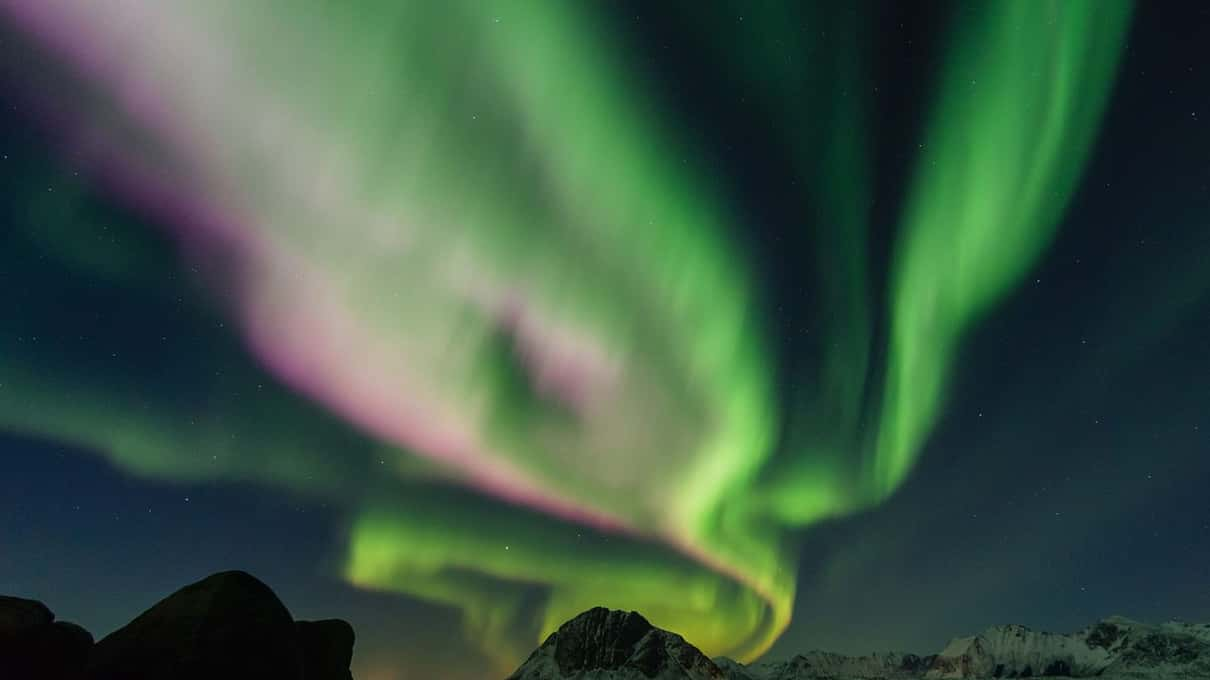
A frame of green sky alone soon looks like every other aurora photo. From the bay you can include the city glow behind you. To the north lies the long flat ridge of Esja across the water, and the low outline of Viðey sits close to town.
Between 9 October and 8 December, a white beam rises into the sky from the Imagine Peace Tower on Viðey. With the aurora behind it, that beam tells anyone the picture was taken in Reykjavik.
Our guide to the best months for a cruise covers when the tower is lit. Elding's cruise from ~$105 passes the lit waterfront too. Harpa and Hallgrímskirkja stay in view for a city frame.
Cold batteries and other limits
Cold empties batteries fast, and a camera can give up after a few dozen long exposures on deck. Carry spares in an inside pocket and swap them as soon as one weakens.
Thin liner gloves let you work the buttons, with mittens over them between shots. Our guide to what to wear on deck covers the rest of the kit for a long wait outside.
Some land tours from Reykjavik include photos of you under the lights, but none of these boats promise any. If you want a picture with yourself in it, ask a neighbor on deck and return the favor.
No setting helps when cloud covers the sky. The retry rules for a night with no lights differ by company, and if a rolling deck worries you, read our seasickness advice before you sail.